Demolition gets really loud: excavators, hydraulic breakers, saws, crushers and the removal of rubble. With mobile acoustic mats and temporary noise walls you keep the noise away from homes, offices and neighbouring plots.
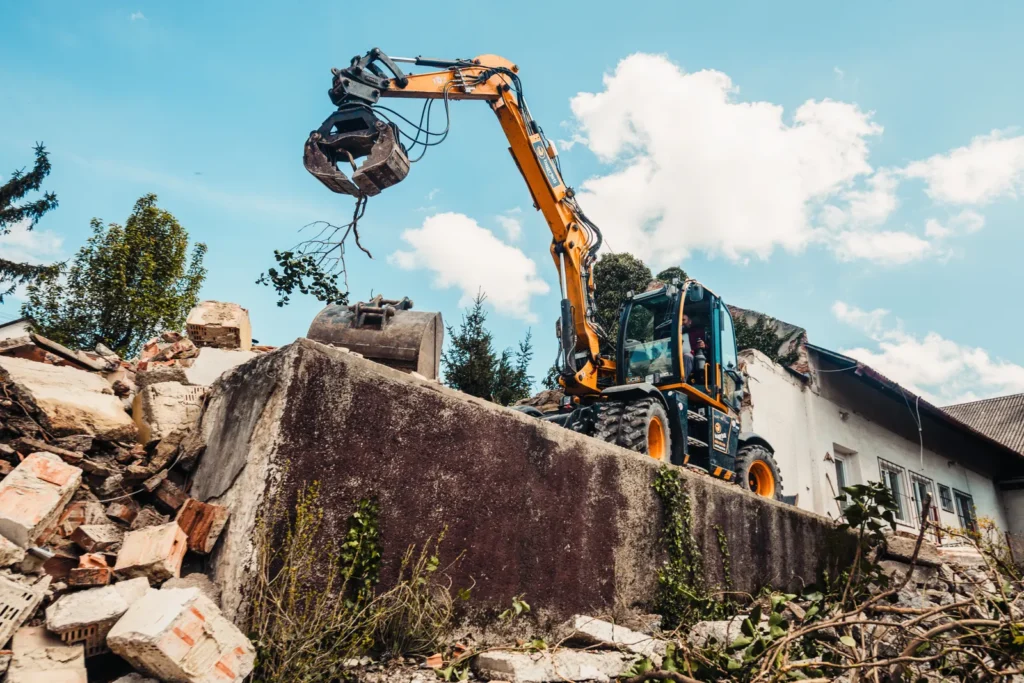 Photo: Pexels
Our noise control for demolition sites
The mats are fixed to stable temporary fencing or support frames. They suit individual loud areas just as well as long screens along the site boundary. Rule of thumb: the closer the barrier stands to the noise source (or to the building to be protected), the better it works.
- fits standard fence panels of 3.5 m × 2 m
- sound reduction index up to 23 dB, depending on the system
- higher walls with a support frame possible
- robust and made for temporary use
- no storage or maintenance costs, because hired
Who is it for?
For construction and demolition contractors, main contractors, project and site management and technical purchasing. Typical uses are dismantling in city centres, sites close to housing, concrete processing, strip-out, recycling yards and temporary work zones.
What we need for planning
Tell us where and for how long demolition will take place, how long and how high the screening should be and what the ground is like.
Think of the wind: acoustic mats offer it a large surface. Fences and support frames must therefore be planned, erected and regularly checked for stability.
Intercepting the sound where it arises
During dismantling the noise moves. Hydraulic breaker, concrete saw and material handling do not stay in one place. Plan the screening for all demolition phases, not just the first day. The mats can be moved with the work area if required.
A closed barrier close to the source works better than a single barrier far away. At the same time, excavators, removal vehicles and escape routes need room. For a reliable quote, a site plan, photos and the approximate positions of the loudest machines help us, as well as:
- demolition method and machines used
- sequence of the demolition sections
- access routes for skips and lorries
- sides of buildings that need particular protection
For the toughest cases – for example next to hospitals – a site enclosure can be the better choice.