Mobile noise control for track works and railway construction sites
Railway infrastructure cannot be maintained without loud construction work – and it often takes place right next to homes, at night and at weekends. With hired mobile noise barriers you screen track worksites quickly and flexibly.
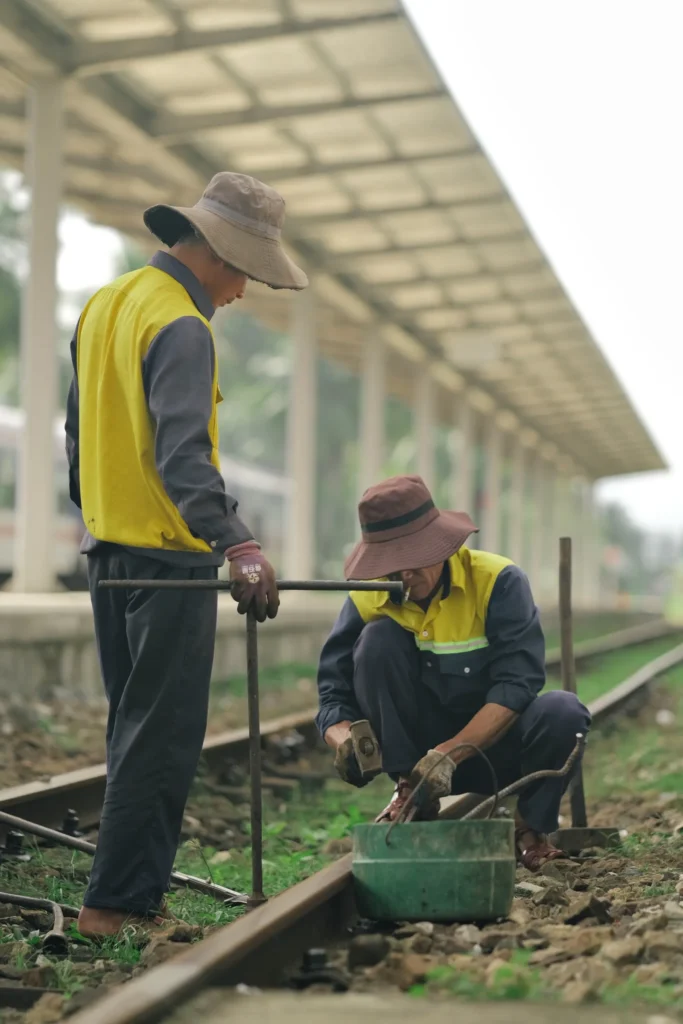 Photo: Pexels
Where construction noise arises on the railway
- Track renewal: rails, sleepers and ballast are replaced completely – with excavators, ballast cleaning machines and track-laying equipment.
- Track maintenance: rail grinding, tamping and ballast compaction keep the line in service, but are anything but quiet.
- Station upgrades: concrete drilling, cutting, demolition and cranes – for example for step-free access.
- Embankment maintenance: brush cutters and mulchers along the line.
- Bridges and tunnels: heavy plant, sometimes even blasting.
- Transport and works trains: lorries and diesel-powered works trains for signalling and overhead line equipment – particularly noticeable in densely built-up areas.
Practical example: tram depot in Berlin
In a tram depot of Berlin’s public transport operator BVG, our flame-retardant acoustic mats were used as an “assembly tunnel”. Work in the hall could continue while construction took place inside the tunnel. According to the project manager, staff feedback was positive overall and the result was a clear improvement over earlier works carried out without an enclosure and acoustic mats.
 Noise control during construction work in a tram depot
The simplest solution: site fence plus acoustic mats
A 2 m temporary fence fitted with sound-absorbing mats, attached with cable ties, is effective and flexible – and it moves along the track with your crew. Where a noise assessment requires more height, mobile noise walls 4 m or 6 m high on a support frame are available.
 Acoustic barrier mats for track works
Rail worksites have to respect noise limits too
In Germany the construction noise regulation (AVV Baulärm) also applies to railway construction sites. Plan the screening early – especially for night shifts – and keep enough distance from the track and other danger zones when positioning fences and support frames. The hirer is responsible for a stable, storm-proof set-up.
A first rough estimate of the achievable effect is possible with our noise barrier calculator.